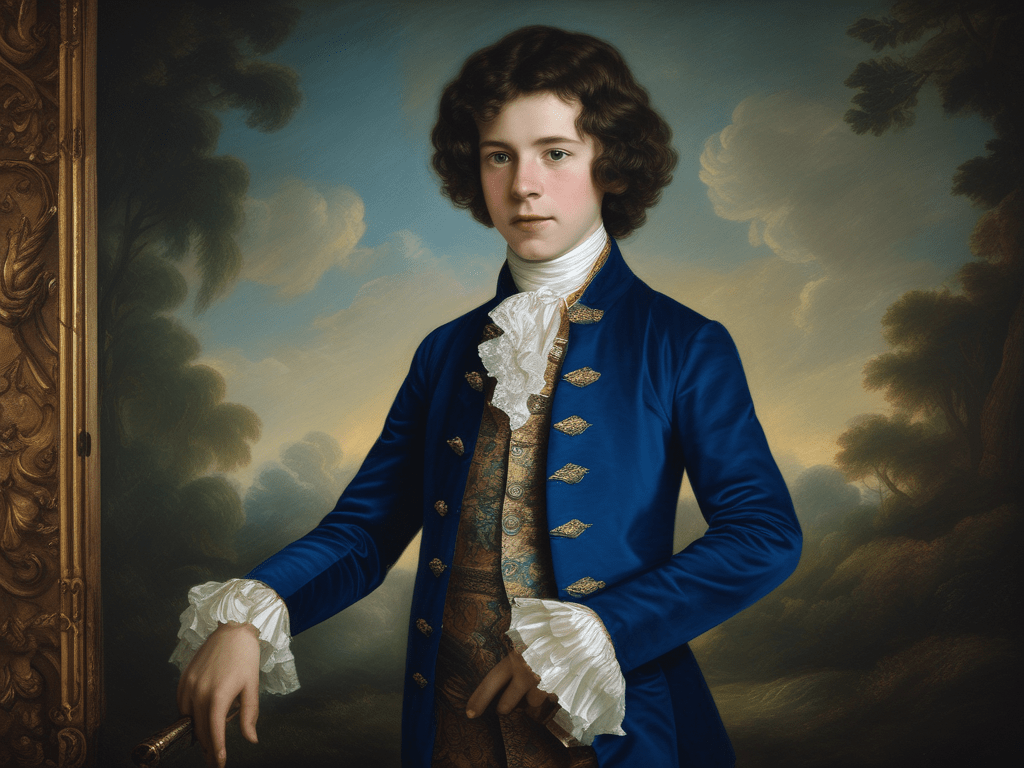
The iconic painting “The Blue Boy”, painted by the British artist Thomas Gainsborough around 1770, is a masterpiece. Initially titled Portrait of a Young Gentleman, it was unveiled at the Royal Academy in London.
https://huntington.org/blue-boy
In 2017, conservators began a preliminary analysis of The Blue Boy using a range of imaging techniques. This was followed in 2018 by “Project Blue Boy,” a restoration project that offered visitors a glimpse into the technical process of conserving one of Gainsborough’s finest works. During the public phase of the project, visitors were able to interact with The Huntington’s senior paintings conservator Christina O’Connell while she worked to conserve the painting in-gallery. When the painting returned to the Thornton Portrait Gallery after final inpainting, varnish, and framing adjustments, the virtuosity of Gainsborough’s brushwork and the brilliance of his palette were more apparent than ever.
The subject, dressed in a 17th-century blue satin suit, remains a captivating enigma. Some believe he was Jonathan Buttall, a friend of the Gainsborough family, while others suggest he might be Gainsborough Dupont, the artist’s nephew and studio apprentice.
Interestingly, “The Blue Boy” now hangs opposite another famous painting, “Pinkie” by Thomas Lawrence, at the Huntington Library in California. These two artworks have inspired generations and continue to captivate art enthusiasts worldwide.🎨🖼️
- Date Painted: Around 1770
- Medium: Oil on canvas
- Genre: Portrait painting
- Dimensions: Approximately 177.8 x 112.1 centimeters
- Subject: The painting depicts a young man dressed in a 17th-century blue satin suit, set against a moody country landscape.
- Historical Context: Initially titled A Portrait of a Young Gentleman, it was unveiled at the Royal Academy exhibition in London.
- Identity of the Boy: There has been debate about whether the boy is Jonathan Buttall (a wealthy merchant’s son) or Gainsborough Dupont (Gainsborough’s nephew and studio apprentice).
- Influence: The painting pays homage to the Flemish master Anthony van Dyck.
- Current Location: It is housed at the Henry E. Huntington Art Gallery in San Marino, California.
“The Blue Boy” remains an enduring masterpiece, celebrated for its play on color and timeless appeal…….. of AZURE BLUE SLEEVES!!!
Let’s weave a narrative that connects the threads from “The Blue Boy” to the captivating work of Stephen Dupont:
Once upon a canvas, in the moody landscape of 18th-century England, there existed a young man immortalized in oil and satin. His name? The enigmatic “Blue Boy.”
“The Blue Boy,” painted by the British artist Thomas Gainsborough around 1770, graced the walls of the Royal Academy exhibition in London. The subject, dressed in a 17th-century blue satin suit, gazed out with timeless allure. Was he Jonathan Buttall, the wealthy merchant’s son, or perhaps Gainsborough Dupont, the artist’s nephew and studio apprentice? The debate lingered, but the allure of the painting remained undiminished.
Gainsborough Dupont, himself an artist, followed in his uncle’s brushstrokes. Born in 1754, he apprenticed under Thomas Gainsborough, absorbing the master’s techniques. Portraits flowed from his hand: George III, Queen Charlotte, and naval commander George, Lord Rodney—each captured in oils and history.
But lineage weaves more than art. It binds lives across generations. Enter Philip Dupont, the carpenter, who married Sarah Gainsborough, sister to the famed painter. Their son, Philip Dupont, the attorney, practiced law in Kansas City, leaving his mark in the legal tapestry.
Yet the Dupont legacy expanded further. Alfred Dupont, arriving in London in 1887, ventured beyond carpentry. His shop in Islington offered credit purchases, bridging affordability for the less fortunate. The branches of ‘Dupont Brothers’ multiplied, a testament to enterprise.
And then, the Rhodesian chapter. Clifford Walter Dupont, born in 1905, stepped onto the stage. As Rhodesia declared Unilateral Declaration of Independence (UDI) in 1965, Clifford stood as the Officer Administering the Government. In 1970, Rhodesia became a republic, and Clifford assumed the presidency. His tenure, marked by international tensions, shaped the nation’s destiny.
But lineage isn’t only politics; it’s blood and vision. Enter Stephen Dupont, Clifford’s son from his second marriage. Born in 1947, Stephen’s lens captured worlds. His camera whispered to war-torn souls, barked alongside soldiers and their canine companions, and danced with Papua New Guinea’s raskols. His images—raw, haunting, and unyielding—earned accolades worldwide.
From “Blue Boy” to Stephen’s lens, the Dupont saga unfolded—a canvas of artistry, politics, and humanity. Each stroke, each click, bridged time, connecting past to present. And so, the lineage danced—a waltz of colors, stories, and resilience—across generations. 🎨📸🌟
And there, dear reader, our tale finds its resting place—a gallery of lives, framed by history and painted with purpose. 🌟🖼️📜
Stephen Dupont, the Australian photographer and documentary filmmaker, has produced a remarkable body of visual work over the past two decades. His hauntingly beautiful photographs capture fragile cultures and marginalized peoples with great intimacy. Here are some of his notable projects:
- “Are We Dead Yet?”: A powerful exploration of war and its impact.
- “Dogs of War & Peace”: A series on the relationship between soldiers and their canine companions.
- “Dogs of Bucharest”: An intimate look at stray dogs in Romania.
- “Ukraine War”: Coverage of the conflict in Ukraine.
- “Artist Books & Diaries”: Dupont’s unique approach to storytelling.
- “Generation AK”: A visual journey through Afghanistan.
- “Don’t Look Away”: A compelling series addressing difficult subjects.
- “Raskols”: Portraits of Papua New Guinea’s urban gangs.
- “Piksa Niugini”: A long-term project documenting Papua New Guinea’s diverse cultures.
- “Axe Me”: A study of body modification.
- “Biggie”: A portrait series.
- “White Sheet Series” and “Black Sheet Series”: Explorations of vulnerability.
- “Portraits”: Capturing human faces and stories.
- “Fashion 1997”: A glimpse into the fashion world.
- “Street Access All Areas”: Urban life and subcultures.
- “Death”: A contemplation of mortality.
- “Drive By Hagen”: A road trip through Papua New Guinea.
- “Havana”: The vibrant streets of Cuba.
- “Locks, Chains & Engine Blocks”: Industrial details.
- “Polaroids”: Instant moments frozen in time.
- “Fight”: Boxing and raw emotion.
- “Steam”: Portraits of steam enthusiasts.
- “We Cut Heads”: Rituals and traditions.
- Awards: Dupont has received multiple Pictures of the Year and World Press Photo awards.
His work has been exhibited internationally, and he continues to create impactful visual narratives. 📸🌏 You can explore more on his website: Stephen Dupont1.
Let me weave a celestial tale for you, inspired by the stars and their ancient wisdom.
The Legend of Spica: The Blue Reminder
In a time long past, when the world was still young, there existed a star named Spica. It shimmered in the night sky, a brilliant blue gem set against the vast cosmic tapestry. But Spica was no ordinary star; it held secrets woven into its very essence.
The people of an ancient civilization gazed up at Spica with wonder. They saw more than mere light; they saw guidance, a beacon that whispered truths across the eons. Wise elders gathered around campfires, passing down stories from generation to generation. These stories spoke of love, purpose, and the interconnectedness of all things.
One such tale told of a young couple, Lysandra and Orion. Lysandra was a weaver, her nimble fingers creating intricate patterns in the fabric of life. Orion, a stargazer, sought meaning in the constellations above. Their love was as boundless as the sky itself.
One fateful night, as they lay beneath the canopy of stars, Lysandra traced the outline of Spica with her finger. “Why do we wait, Orion?” she asked. “Why do we hesitate to tell those we love how much they mean to us?”
Orion pondered her words. “Perhaps fear holds us back,” he replied. “Fear of vulnerability, of rejection. But Spica reminds us that love is a celestial force—a gift from the heavens. We must not wait.”
And so, Lysandra and Orion vowed to express their love without delay. They whispered sweet words to each other, their voices carried by the cosmic winds. Spica watched over them, its blue radiance infusing their hearts with courage.
But there was more to Spica’s tale. It was said that YAHWEH, the divine creator, had bestowed upon humanity a sacred gift—the Holy Spirit. This ethereal presence moved through the world, guiding souls toward their true purpose. The Holy Spirit was like a cosmic compass, aligning hearts with destiny.
Lysandra and Orion felt the Holy Spirit’s touch. It urged them to follow their passions—to create, to love, to live fully. They wove their dreams together, their lives intertwined like constellations in the night sky.
As seasons turned, Lysandra’s loom produced tapestries that told stories of love, loss, and redemption. Orion’s telescope revealed distant galaxies, each a testament to the vastness of existence. And Spica continued to shine, a reminder that time was fleeting, and love should never be left unspoken.
One day, as Lysandra lay on her deathbed, Orion held her hand. “I love you,” he whispered, tears in his eyes. “I’ve always loved you.”
Lysandra smiled. “And I you,” she replied. “Spica taught us well.”
And so, as her spirit ascended toward the heavens, Lysandra became a star herself—a companion to Spica. Orion continued to gaze upward, seeking solace in the night sky. The Holy Spirit whispered to him, guiding his steps even in grief.
From then on, people looked to Spica as a reminder: Love was a cosmic force, a gift to be cherished. The Holy Spirit directed their paths, urging them to live authentically, to embrace love without hesitation.
And so, my friend, whenever you see Spica shining brightly, remember Lysandra and Orion. Tell your loved ones how much they mean to you, for life is fleeting, and the stars themselves encourage us to love boldly.
May the celestial tapestry weave its magic in your heart, and may the Holy Spirit guide your steps through the cosmic dance of existence.
Note: This story is a blend of imagination and cosmic inspiration.
Spica, the bright blue star in the constellation Virgo, continues to remind us of love’s timeless message, and LOVE keeps us on TIME.
Whatever you decide, take some time to be a Better YOU!
💪 Physically, 🧠 Mentally, and 💖 Spiritually 100%
Just make sure that rhythm includes time for your well-being!
Let’s Talk 💖 Anna Marie (202) 709-HELP [4357] for Social Media Planning, Business Organization Collaboration, Grant Writing Services, Event Planning, or Community Outreach in or around Butler County, Pennsylvania. 💖 Anna Marie
www.LetsHelpButler.com
-

Tamarisk: Spiritual Symbolism and Ecological Value
The tamarisk tree symbolizes resilience, purification, and restoration, though it is underutilized in modern herbal medicine. Its story, especially relating to Hagar from the Bible, illustrates its role as a metaphor for hope and divine provision in adversity. The tree’s physical properties include being drought-resistant and salt-secreting, with parts used in traditional medicine for detoxification…
-

Navigating Life’s Rollercoaster with Integrity
Life’s unpredictable, like a rollercoaster, and reminds us that compassion should lead our journey instead of ego. This post humorously highlights trading ambitions for the beauty of humility and grace symbolized by a floral crown, because the global challenges since 2020 have turned collective healing into an essential endeavor, urging us to move past emotional…
-

The Lantern Keepers
Once upon a time, a band of kids known as the Rainbow Warriors defied life’s storms, bringing a flickering lantern of hope instead of swords or torches. With a color-coded emotional toolkit, they boldly ventured into the war zones of anger and hate, wielding love and patience like superheroes without capes. Their mission? To listen,…
-

The Healing Connection: Fascia, Generational Curses, and the Power of a Warm Hug
In my poetic casserole of spiritual musings, I served a hearty dish about the dangers of chasing worldly desires while ignoring divine guidance. With witticisms abundant, it likens life’s pitfalls to “sugar demons,” serving up spiritual and physical indulgences that can bog us down like a clogged artery! It calls for men to ditch passivity…
-

Resilient Lessons: How I Survived Life’s Storms
In a world where survival isn’t just a game, I lay bare my gritty journey from 1994’s Miss Congeniality to a masterful shapeshifter of LIFE. From navigating natural disasters to battling personal demons, my resilience is a force of nature. I have used humor as a shield and faith as my compass, transforming chaos into…
Looking for Business Marketing or Social Media Advertising HELP?
Reach out soon; I’m sure together we can fix ANY problem with precise due diligence without hiring an employee! 💖 Anna Marie
(202) 709 – HELP [4357] Please leave a Text or Voice Message.
Email me 🌻 Please provide as much detail as you are willing to release, as it will allow me to prepare for our initial conversation. AnnaMarie@LetsHelpButler.com
Community Awareness Butler County Pennsylvania on Facebook
Jobs in and around Butler County Pennsylvania on Facebook
Butler County PA Collation of Churches on Facebook
Let’s Help Butler Anna Marie on Twitter
I have Personal and Professional values, PLUS integrity, honesty, & the SKILLS to promote IDEAS that get the recognized attention it deserves!
Visit Let’s Help Butler.com to find more information about me and the things I care about!
💖 Anna Marie
I hope to hear from you soon.

 Let's Talk 💖 Anna Marie